
[This message was delivered at Perinton Presbyterian Church on June 23, 2024, based on Mark 4:35-41.]
Late that day he said to them, “Let’s go across to the other side.” They took him in the boat as he was. Other boats came along. A huge storm came up. Waves poured into the boat, threatening to sink it. And Jesus was in the stern, head on a pillow, sleeping! They roused him, saying, “Teacher, is it nothing to you that we’re going down?”
Awake now, he told the wind to pipe down and said to the sea, “Quiet! Settle down!” The wind ran out of breath; the sea became smooth as glass. Jesus reprimanded the disciples: “Why are you such cowards? Don’t you have any faith at all?”
They were in absolute awe, staggered. “Who is this, anyway?” they asked. “Wind and sea at his beck and call!” (Mark 4:35-41, in “The Message.”)
If I could have a dollar for every time I have been asked to pray for good weather, I’d be a wealthy person. “Pastor, will you pray that we will have good weather for the picnic?” No. “Pastor, will you pray for good weather for our daughter’s softball game?” No. “Pastor, will you pray that the heat wave will break?” No. (Well, maybe.) I have a stock answer to such appeals. With all that is wrong in our world—the scourge of disease, wars, hunger, racism, millions of refugees needing homes, for starters—I have more to pray about than the weather. But, I have an exception: when lives are in danger, I will pray about the weather. When a twister or a hurricane is threatening human lives, I will certainly pray for God’s intervention.
The disciples on that storm-threatened boat don’t ask Jesus to do something about the weather. “Teacher, is it nothing to you that we’re going down?” That sounds rather fatalistic and self-centered. They could have asked, “Lord, storm is about to take our boat down. Is there anything you can do?” In this narrative that is punctuated by four questions, this is the lead question: “Teacher, is it nothing to you that we’re going down?”
The adventure begins innocently enough: Late that day he said to them, “Let’s go across to the other side.” What’s on the other side? A beach or a harbor? Maybe a little resort village? People like to vacation where there is water. Or perhaps there are people in great need on the other side. Some people have this natural curiosity about what is on the other side. I am one of them. Some of you are too. In his book “Undaunted Courage,” historian Stephen Ambrose follows Lewis and Clark on their great expedition to find the western end of the continent. President Jefferson commissioned them to get to the other side. When they finally got through the plains, so vast and flat, they saw mountains rising from the land. “Aha,” they thought. “When we reach the summit of those mountains, we’ll see the Pacific Ocean.” At the peak of every mountain ridge they saw another mountain ridge. There was, it seemed, always another mountain ridge. Until the last one, where standing on the ridge they finally saw the Pacific Ocean, the other side.
“Let’s go across to the other side.” That is Jesus talking. What can we do but get in the boat and start the adventure? The Sea of Galilee, which is a lake, is about 13 miles from north to south and eight miles at the widest, like one of the Finger Lakes, except wider. The other side for Jesus and his disciples is probably under eight miles. Since some of them had made their living by fishing, they know the lake well. They know about sudden storms.
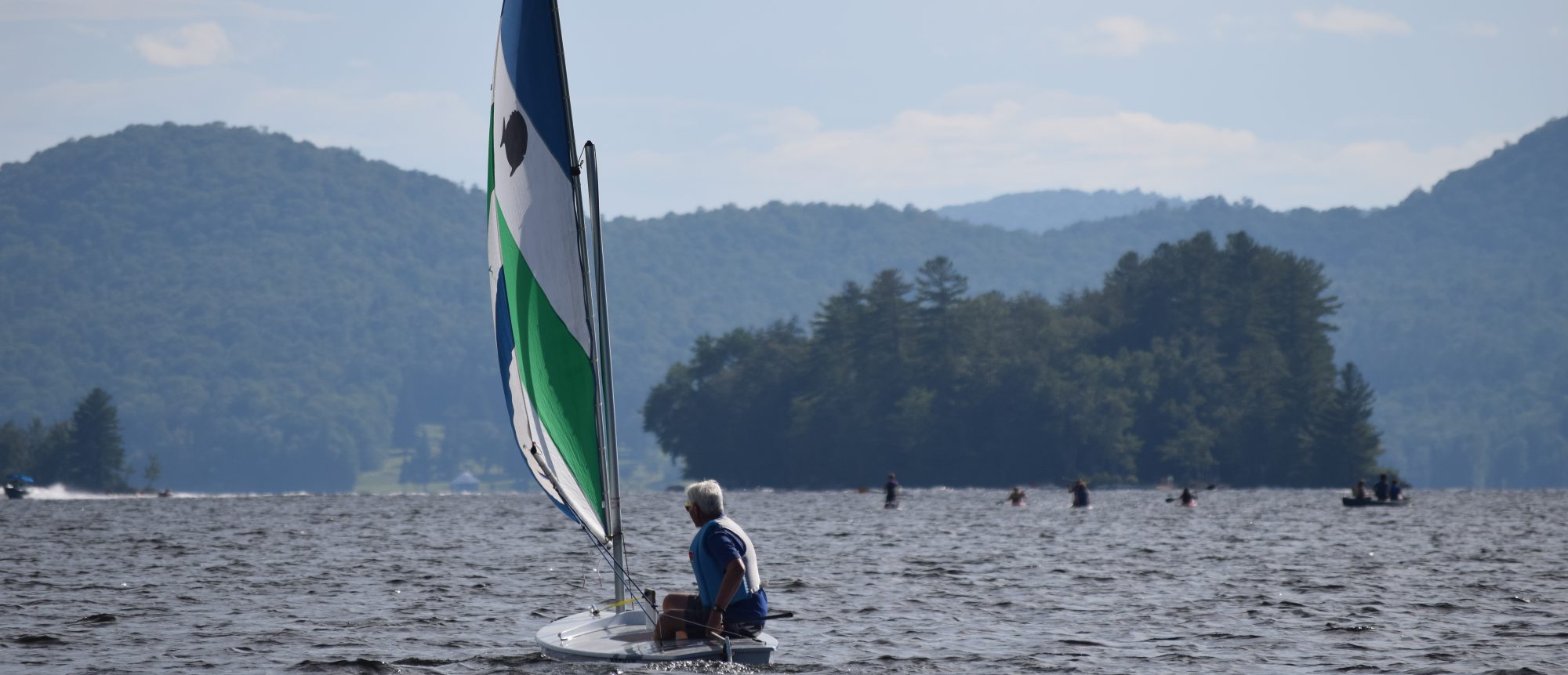
I have been to the Sea of Galilee twice. I didn’t bring my Sunfish sailboat along, but I went on boat rides. It is a beautiful lake, situated in the Jordan Valley rift, making it the lowest freshwater lake on earth, well below ocean level. Because it is in a geological rift, it is susceptible to earthquakes and sudden storms. On both east and west shores there are mountain ridges, again like many of the Finger Lakes, creating a funnel effect. This means that storms can arise quickly, usually moving from south to north. I have experienced such storms many times on Conesus Lake, near here, and Lake George at the eastern end of New York, and on Lake Pleasant in the Adirondacks. If you want to sail with me on my little Sunfish, I will ask you two questions: 1. Are you a good swimmer? and 2. Will you be ok if the boat tips over? If you can’t answer yes to both questions, you are not going sailing with me.
“Let’s go across to the other side.” That is a biblical theme. From the people of ancient Israel crossing the Red Sea to escape slavery in Egypt, to their crossing the Jordan River to re-enter their ancestral homeland, to Jonah sailing west to escape God’s call to go wicked Nineveh, to the apostle Paul sailing west to bring the Good News to Rome and then hoping to go further west to Spain. There is adventure in wanting to go across to the other side.
And now they are sailing across Galilee to the other side when a treacherous storm comes out of nowhere. Water is crashing into the hull of the boat. And Jesus is asleep, his head on a pillow while. Almost 40 years ago the hull of an old boat was found on the bottom of Galilee. It was carefully lifted out and restored. It is 27 feet long, 7.5 feet wide, and 4 feet deep, carrying about 15 people. It is called “the Jesus boat,” because it is the kind of boat Jesus and the disciples were in that day. It is a worthy craft, but no match for a treacherous storm.
Jesus is asleep in the storm. When we are caught in a storm of life, does it ever seem to us that Jesus is asleep? We aren’t alone. In Psalm 44:23-26, the writer cries out:
Get up, God! Are you going to sleep all day? Wake up! Don’t you care what happens to us?
Why do you bury your face in the pillow?… If you love us so much, Help us! (“The Message”)
And the disciples ask Jesus: “Teacher, is it nothing to you that we’re going down?” Jesus awakens and sensing how troubled his friends are, he commands the storm to stop. The storm has no choice, as Lazarus had no choice when Jesus called him out of a tomb. At his command it stops and the surface of the lake becomes like glass. Jesus has two questions for them: “Why are you such cowards? Don’t you have any faith at all?” Not even Peter dares to answer this time. Who wants to be called a coward by Jesus?
Mark uses two words for fear in these two verses (40-41). While both can be translated fear, they are different. The first one means cowardice. “Why are you such cowards?” That is a strong indictment by Jesus and indicates how disappointed he is when they are so fearful. The second word is the more common New Testament word for fear, which in the original language is phobia, a word we have carried over into English. “The Message” catches it correctly: “They were in absolute awe, staggered.” That is not cowardice, but healthy awe, a different kind of fear, one that is commended to us in fearing God, that is, holding God is absolute awe. For those disciples, at first the storm was the occasion for cowardice, but then because of Jesus, the occasion for awe. We want to know that kind of fear when we are in storms of life, a healthy awe at the presence and power of Jesus.
Not only do I love sailing, but I love baseball. When Willie Mays died five days ago, there was a hole in my heart. As a youngster and youth, I saw him play against my Dodgers. The say hey kid was the best player I ever saw. But I didn’t know about his good friend Bill Greason. Now I do. As the oldest living Negro leaguer, the 99-year-old Bill Greason has had an amazing life. He grew up across the street from Martin Luther King in Atlanta. He served in WW II, surviving the battle in Iwo Jima, then returned home to the Jim Crow segregation telling him what he couldn’t do. But he could play baseball. He became the first Black pitcher in St. Louis Cardinals history in 1954 and no white player on that team would speak to him for the whole season. He was married to the same woman for 65 years before she died and continues to serve as a minister at his church after 53 years. An early lesson from his mother resonated as a guiding principle. “The way up is down,” Greason said. “It was a paradox. My mother told me: ‘Humble yourself, and you’ll be lifted up. But if you exalt yourself, you’ll come down.’”
So it is with storms in life. They test us. They humble us. They reveal who we are and what we believe. They drive us to Jesus. And he leaves us in absolute awe. There is a fourth question in today’s narrative: “Who is this, anyway,” they asked. “that wind and sea obey his voice?” On to the adventure of following Jesus to the other side of the lake. On through any storms that life throws at us. Following Jesus is not for cowards. We live in absolute awe of the one at whose voice wind and sea obey.
 Sailing toward Wisdom